Adaptive Crafting: Making Creative Projects Accessible
Hands change with the years. Grip softens, eyes ask for more light, and an hour at the table is felt the next morning. None of that has to mean putting the needle down. Adaptive crafting is simply the practice of changing the tool or the routine so the work still fits the person doing it.
What follows is how that looks in a real room, from handles and lighting to the way a table is laid out and how a working session is paced. None of it is complicated, and most of it costs very little.
Why a Small Change Is Usually Enough
Adapting a craft is not about setting it aside and taking up something simpler. It is about finding the one or two places where the project fights you, and taking the fight out.
Often that is a single detail. A shorter needle, a magnet instead of a pin, a clamp that holds the hoop so both hands stay free. One change can give you back an entire hour of comfortable work.
Start by noticing where the difficulty actually sits. Is it gripping, reaching, seeing, or simply sitting too long in one position? The answer points straight at the fix.
Change one thing at a time, and keep the change that helps. A whole new set of tools in one go is confusing as well as expensive. That is the whole method behind adaptive crafting: one adjustment, tried in use, then kept or set aside.
Grip, Vision and Sitting
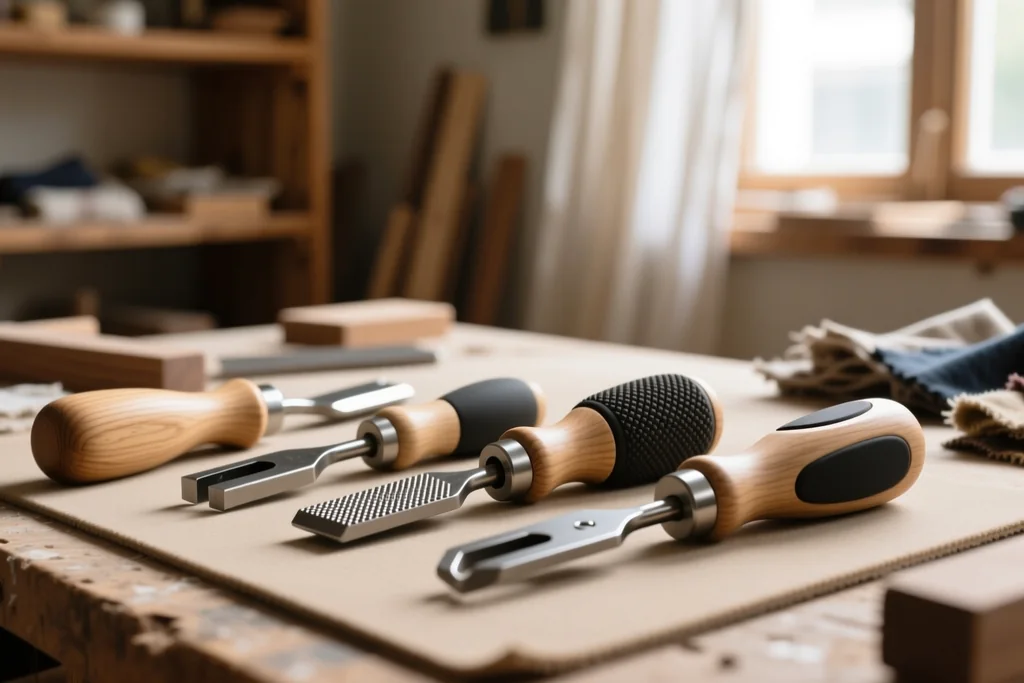
Grip is the commonest complaint. Thin tools demand a tight pinch, and a tight pinch is exactly what sore knuckles dislike most. A handle two or three times thicker makes the same stitch with far less effort.
Vision asks for contrast as much as for brightness. Dark thread on dark cloth is hard work at any age, and a bright task lamp costs far less than the frustration it saves. A pale cloth under dark thread does more still.
Sitting is the quiet one. A chair without support turns twenty pleasant minutes into an afternoon of backache, and a cushion is cheaper than any craft tool. Feet flat on the floor make a surprising difference too.
None of these changes requires a diagnosis or a new hobby. They simply put the craft back within easy reach.
Matching the Tool to the Task
Most adaptations fall into a few familiar groups. The table below sets out the common difficulties and the changes that answer them. Read it as a menu rather than a prescription.
| Difficulty | Adaptation | Why it helps |
|---|---|---|
| Weak grip | Thicker handles, foam sleeves, ergonomic grips | A fuller hand needs far less pinch pressure |
| Sore joints | Larger needles and hooks, shorter sessions | Less repeated force through the fingers |
| Reduced vision | Bright task lamp, high-contrast thread, larger charts | The eye works with less strain and fewer mistakes |
| Tremor or unsteadiness | Clamps, non-slip mats, weighted bases | The work stays still while the hands take the rest |
| Fatigue | A raised stand, a lap tray, frequent short breaks | Arms are supported instead of held up |
None of this requires a special shopping trip. Foam tubing from a hardware shop slides over a slim crochet hook, and a simple clip will hold a chart upright at eye level. Both take minutes to set up, and neither changes what you are making.
Setting Up a Table That Helps
A good crafting table puts everything within reach without a stretch. The tools you use every minute sit nearest, and the ones you use once an hour sit further away. That single rule saves more effort than any gadget.
Raise the work if reaching down is painful. A stand, a cushion on the lap or a box under the project brings everything closer to the body, and keeps the shoulders relaxed.
Keep the light in front of you rather than over your shoulder, so your own hand does not throw a shadow across the stitches. A lamp with a flexible arm can be moved as the work grows.
A Slower Routine That Still Finishes Things
Long sessions are not the goal. Short and regular finishes more work than one exhausting afternoon every fortnight, and it is far kinder to the hands.
Set a small, clear target for each session: one seam, a row of stitches, a handful of squares. Stopping at a finished point feels much better than stopping halfway along a row.
Leave the work ready to pick up again. Thread the needle, lay out the next pieces, and starting again becomes easy rather than a decision.
Sharing the Work
Crafting alone is perfectly fine, but it gets easier when someone else is doing it nearby. Conversation fills the pauses, and problems often solve themselves out loud.
- Work in pairs on a large project, one cutting and one sewing.
- Ask a friend to read a pattern aloud while you follow the steps.
- Trade tasks you find difficult for tasks you find easy.
- Keep a shared box of adapted tools so anyone can try a different grip.
- Show finished work, however small, so the effort is seen.
None of this needs organising. It can simply be two people at the same table on a Tuesday.
Keeping the Pleasure In It
The point of adaptive crafting is not to keep producing at the old pace. It is to keep the pleasure of making something with your own hands.
Choose projects that suit the hands you have now: smaller pieces, bolder colours, tools that fit. A pincushion finished today is worth more than a quilt postponed for a year.
Adapt the tool, shorten the session, brighten the light, and the craft stays. Adaptive crafting is not a compromise, only the version of the work that suits today.