
Decorating the House for New Year and Christmas
The winter holidays arrive with a long list of small jobs, and decorating the house is the one nobody wants to rush. When the light stays grey, the rooms we sit in matter more than usual. Good new year home decor is less about buying a great deal and more about deciding what each room should do for the people in it.
I have dressed the same house for many winters, and my plan gets simpler every year. One box of textiles, one box of lights and one box of ornaments all go out in the same order. Below is how I decorate for New Year and Christmas room by room, with ideas you can change to suit your own home.
Start With the Rooms You Use Most
Before anything leaves the boxes, I walk through the house and ask which rooms we use in the evening. The living room, the kitchen and the hallway always earn their decorations first. A spare room that stays closed needs nothing at all.
The hallway deserves more attention than it gets, because it is the first thing anyone sees. A wreath on the door, a warm light and a bowl of natural materials set the mood before a guest takes off a coat.
Once the everyday rooms are done, whatever is left goes into the quieter corners. I would rather have three rooms that feel finished than six that feel half dressed. It also means less to clear away in January.
Lights, Garlands and the Front Door
Lights do more for a winter house than any other decoration, and they are easy to get right. I prefer a warm glow to a cold one, and I hang them where the colour lands on a wall rather than into open air.
Garlands have the same effect in daylight, when the lights are switched off. One made from felt, fabric scraps or dried materials suits almost any style of home.
Outside, I keep it simple and weatherproof. A wreath on the front door, made from pine, cones or dried fruit, is enough to say the house is ready for visitors. Anything that will not survive the cold stays indoors instead.
A Colour Plan That Holds the House Together
Winter is the one time of year when I plan colour before I plan objects. Choose two or three colours and let them repeat in every room. The table below is the framework I use.
| Room | The change that matters most | Why it works |
|---|---|---|
| Living room | softer throws, cushions and one warm light | the room you sit in sets the mood for the whole house |
| Front door and hallway | a natural wreath and a small lamp | the first impression, before anyone comes inside |
| Dining table | a cloth runner, candles and plain dishes | the meal feels like an occasion for very little work |
| Bedroom | one winter quilt or a soft blanket | carries the festive feeling into the evening |
| Kitchen | a bowl of cones and a string of small lights | high impact for very little effort |
Three colours is usually plenty: a warm neutral, a deeper shade and one bright accent used in small amounts. When every room borrows from the same handful of colours, the house looks considered rather than crowded. It also makes shopping simple.
I keep the accent colour in the smallest quantities, on ribbons, candle holders and a few ornaments. If a scheme feels heavy, the answer is to take something away rather than add. A calm plan with strong light reads as festive without clutter.
Textiles Carry the Winter Look
As a sewer I lean on fabric more than on plastic, and winter suits it perfectly. Quilts, throws and table runners add warmth that a bought ornament never manages.
Winter textiles should feel soft and matte rather than shiny. Wool, flannel, brushed cotton and heavy linen all suit cold months, and they hold the deeper colours well. A plaid or a calm pattern reads better at a distance than a fussy print.
If you sew, one runner or one cushion cover is a pleasant project for a slow afternoon. If you do not, a plain throw in a good colour and a folded quilt on a chair do the same job. Soft plaid over a sofa is the oldest winter trick there is.
The Table, the Scent and the Small Touches
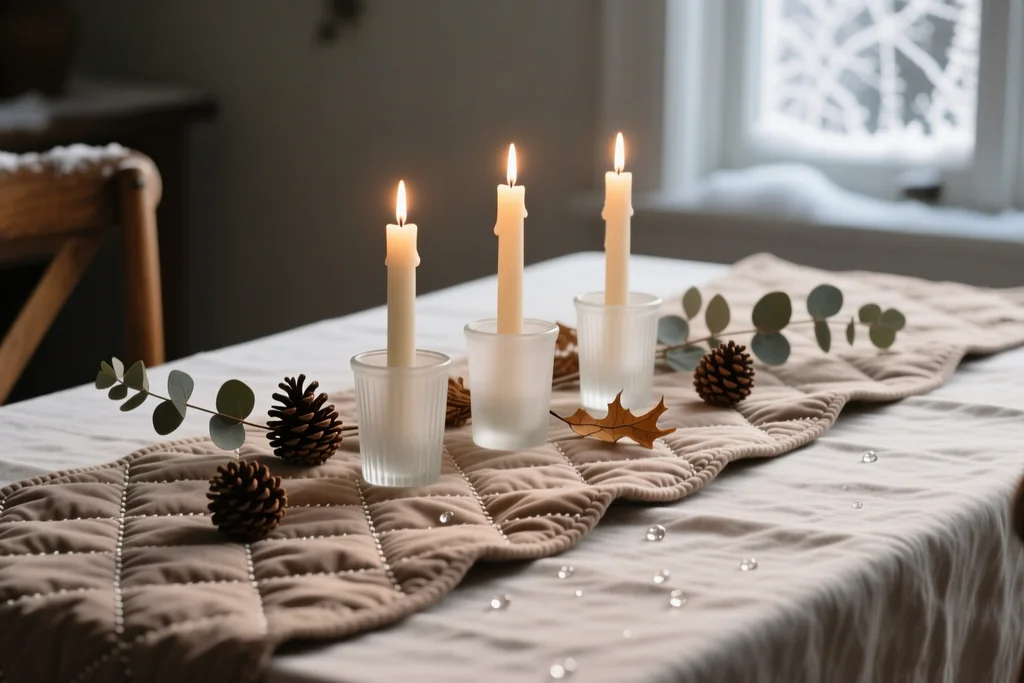
The table is where the holidays are actually celebrated, so it deserves more than a centrepiece. A cloth runner, familiar dishes, candles and fabric napkins make a table feel special with no new purchase. The candles matter more than the china.
Scent is the part people remember and the part they rarely plan. Cinnamon, orange, clove, pine and vanilla are winter smells for a reason, and one candle will carry a room.
Small details make a house feel lived in rather than staged. Jars of sweets in plain glass, a ribbon on a chair back, a sprig of greenery on a shelf. None of it takes long, and all of it is noticed.
Handmade Details Worth the Evening
The decorations I keep year after year are the ones I made, and they are usually the simplest. A handmade piece also makes a good gift for a neighbour, which matters when the holiday list gets long. These are the winter projects I return to.
- Fabric bunting in your chosen colours, cut from scraps in a single evening.
- A quilted table runner or placemats that are used and admired all season.
- Felt ornaments and small stuffed shapes for the tree or a window.
- Handmade gift bags sewn from cotton and finished with lace or applique.
- Covered photo frames dressed with fabric and small decorations.
Handmade pieces also let you use what you already own. Scraps from a quilt, an odd button, a ribbon saved from a parcel, a length of old lace. Winter decorating is a good excuse to turn those leftovers into something that will be seen.
The one rule I follow is to finish what I start. A half-made garland in a bag is not a decoration, and it will still be there next December. Small finished projects give far more pleasure than an ambitious one that never hangs.
Making It Feel Like Yours
New year home decor works best when it looks like the people who live in the house. Borrow ideas freely, then leave out whatever does not suit your rooms or your habits. A decoration you find fussy will feel fussy every year.
If you are starting from very little, begin with light and textiles and let the rest wait. Those two change how a room feels more than any ornament can, and both can be built up slowly over several winters. There is no deadline.
Put the boxes away in the same order you filled them, and January will be easier. Then sit down in the rooms you have made, because that was the point all along.