Fabric Wall Art: Simple Projects for a Cosy Home
Fabric wall art is the quickest way I know to warm up a wall that feels empty. A stretched panel or a small quilt costs very little, uses cloth you may already have, and can be swapped with the seasons without touching a paintbrush.
I began hanging textiles years ago, when a large wall in a spare room stayed bare through three winters. What started as one stretched remnant turned into a habit, and now there is usually something made of cloth on almost every wall of the house.
Why Fabric Works on a Wall
Cloth softens a room in a way that framed paper cannot. It absorbs a little sound, holds colour gently and catches the light differently through the day, so the wall feels settled rather than bare.
Fabric is also forgiving. A woven pattern hides small inaccuracies, and a seam that wanders disappears once the piece is stretched and hung. That makes it a kind project for hands that are not as steady as they once were.
The materials are cheap or free. Remnants, worn linens, the backs of old shirts and the offcuts from bigger projects all work. What a wall piece asks for is a frame or a hanger and an hour at the machine.
Choosing Fabric for the Wall
Colour and pattern matter more than fibre, because a wall piece is looked at rather than used. Start from something already in the room, a cushion or a lamp shade, and let the hanging echo it instead of competing with it.
Weight matters as well. A firm medium-weight cotton holds a crisp edge over a frame, while loose weaves and slippery fabrics sag and show every wobble. If the cloth is very light, back it with plain cotton before stretching.
Strong light is the one thing worth planning around. Sun fades any dyed cloth over the years, so a bright window wall will gently soften the colours. Moving pieces between rooms every so often evens that out.
Scale is the last decision and an easy one to miss. A tiny print stretched over a large frame disappears at a distance, and a very large motif cut down to a small panel looks cropped. Hold the fabric up against the wall before you commit the staples.
Stretching Fabric Over a Frame
A stretched panel is the simplest version of the idea and the one I suggest first. You need a stretcher frame or a deep picture frame, fabric several inches larger than the frame, and a staple gun or a small tack hammer.
Centre the motif before you attach anything. Fold the cloth over the back edge, working from the middle of one side to the middle of the opposite side, and keep the tension even as you move around the frame.
Corners decide whether the panel looks made or hurried. Fold them the way you would wrap a parcel and trim the excess so no bulk shows through the front. A warm iron over the back settles the cloth and sharpens the edge.
Mini Quilts and Textile Hangings
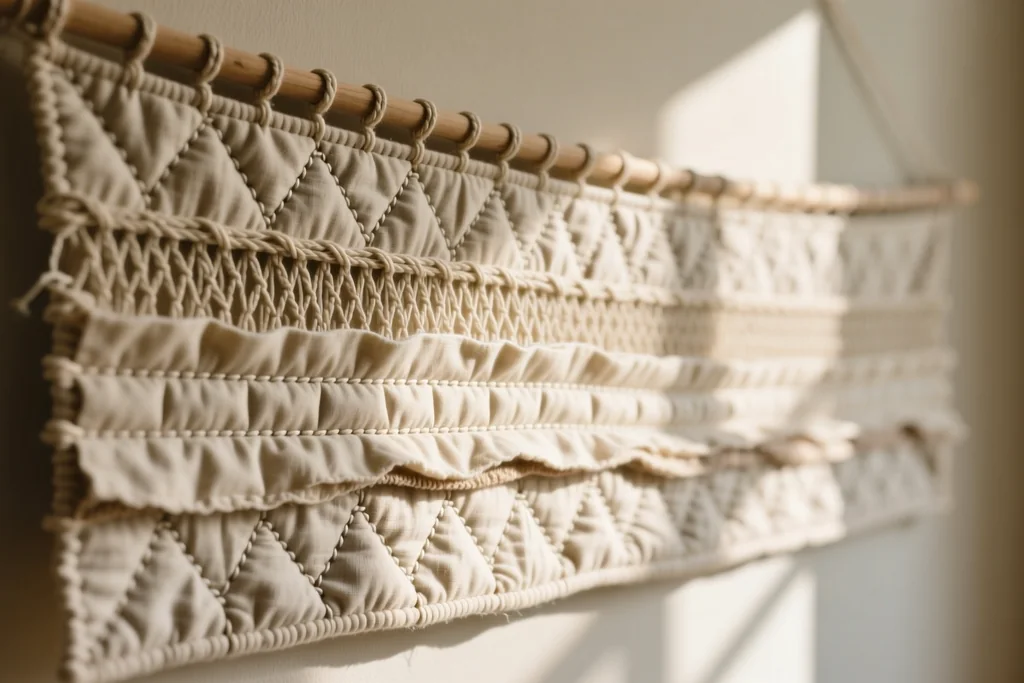
A small quilted piece is a hanging with texture. Even a plain arrangement of squares with straight stitching across it reads as a considered panel on a wall, especially in a room that has little pattern elsewhere.
Keep the scale in mind. A hanging for a narrow wall is usually better slightly smaller than your first instinct, because a long and heavy piece is far harder to hang neatly and to keep straight.
The back matters as much as the front. Stitch a sleeve of fabric across the top of the reverse and run a thin dowel through it, and the piece will hang flat instead of pulling at the corners. This is the kit I keep together for wall pieces.
- A staple gun with short staples, or a small tack hammer and brass tacks.
- A stretcher frame or a deep frame in the size you want.
- Firm cotton fabric, cut several inches larger than the frame.
- A dowel or thin rod and a strip of fabric for a hanging sleeve.
- A warm iron and a pressing cloth for the final finish.
Texture is what makes a textile hanging interesting close up. Mixing a plain weave with a fine stripe, or setting a smooth panel beside a nubbly linen, keeps the eye moving across the piece. Two or three textures are enough for it to look deliberate.
Hanging It Straight and Keeping It Clean
There are three common kinds of fabric wall piece, and each one asks something different of you. The table below sets them side by side, and it is worth choosing the format before you choose the fabric.
| Type | Fabric that suits it | How it hangs |
|---|---|---|
| Stretched panel | firm medium-weight cotton | over a frame, stapled at the back |
| Quilted hanging | pieced cotton with thin batting | on a dowel through a fabric sleeve |
| Loose banner | light cotton or linen | from a rod, weighted at the bottom |
Hanging hardware matters more than most people expect. Two hooks rather than one, set level with each other, keep a wide piece from tilting. For heavier hangings, screw into a stud or use a proper wall anchor.
Textiles collect dust, and a gentle clean is enough. Run a vacuum on low with a cloth over the nozzle, or take the piece outside on a dry day and brush it. Washing is rarely necessary and is hard on the shape.
Where the piece hangs matters as much as how. A hanging set a little above eye level reads as part of the room, while one that sits lower crowds whatever is beneath it. Mark the two hook positions with a pencil and a level before you drill.
A Wall That Changes With You
Fabric wall art is easy to move, so treat it as something you can rearrange. A piece that has hung in one place for years feels new again in another room, and nothing is wasted when a colour stops pleasing you.
Making a piece for a particular wall also solves a real problem. An awkward narrow space or a blank stretch above a sideboard is difficult to furnish, and a hanging answers it in an afternoon.
Start with one panel in the room you use most. The wall will look warmer at once, and the second piece will be easier than the first.