Setting Up a Small Sewing Room
Sewing does not need a whole room. Most of what a project actually requires is a flat surface, decent light and somewhere to leave the machine set up between sessions. That is why sewing room ideas are less about square footage than about the order in which things sit.
This is the arrangement I settled on after years of working in a corner of a spare bedroom: light first, then the surfaces, then storage that closes so the space can become something else again by evening.
Start With the Light
Light decides where everything else goes. Sit with the window on your left if you are right-handed, so your own hand does not cast a shadow over the needle. If that means the machine faces an awkward wall, move the machine rather than the window.
Daylight is best, but it moves and then it goes. A lamp you can pull close to the needle does more for tired eyes than a bright ceiling fitting behind you. Look for a flexible arm and a shade that keeps the glare off the fabric.
Watch for glare on a pale tabletop in the afternoon. A matte cutting mat, or a cloth over a shiny surface, stops the light bouncing straight back at you. Try the room at the hour you usually sew before you change anything.
The Table and the Chair
The machine should sit so your forearms rest level with the bed of the machine. If the table is too high your shoulders lift, and if it is too low your back rounds within the hour. Sit down and try it before you move anything else.
An ordinary dining table is often the right height for sewing and cutting alike. Folding tables can work well, but check that they do not wobble once the machine starts running. A rubber mat under the machine settles most of that.
The chair matters more than the table. One with a back you can lean into and a seat you can stay in for an hour will keep you sewing far longer than any gadget bought to save time.
A small cushion behind the lower back is an easy fix when a chair is not quite right. So is a footstool, which takes the ache out of the backs of the legs and stops your feet dangling in the air.
Cutting and Pressing in a Small Space
Cutting needs room to spread fabric flat, and pressing needs a firm surface with the heat under control. In a small room these two jobs have to share the same corner, and that is workable as long as each one can be cleared away.
An ironing board that folds away and a cutting mat that lifts behind a door can both serve the same table. Set them up when you need them, and put them away when you do not. Clearing up afterwards is what keeps the room liveable.
Keep the iron within arm's reach of the table but never on it. A clear, heatproof spot beside the cutting mat saves a surprising amount of walking, and it removes the risk of scorching fabric under a hot soleplate.
Storage That Closes
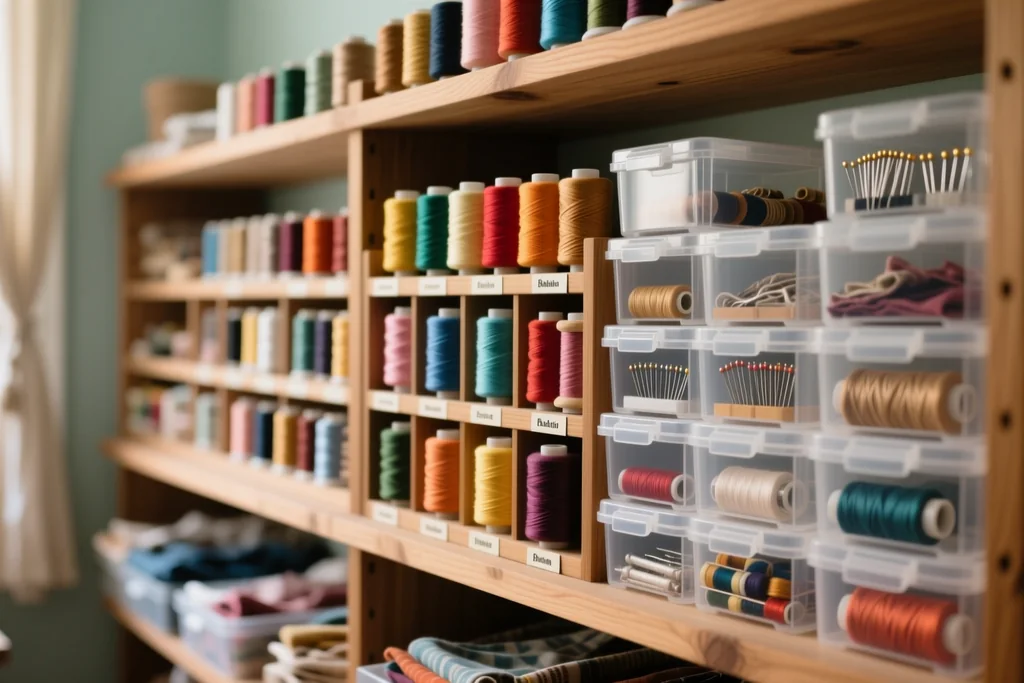
The trick in a shared room is that everything has a home, and the home has a lid. Open shelves look lovely until the fabric stack begins to slide, and dust settles on whatever cannot be closed away.
Think in zones, and give each one a container. The table below sets out what usually belongs where, and why it helps to keep it there.
| Zone | What it holds | Why it works |
|---|---|---|
| Under the table | Boxes of fabric sorted by colour or size | Out of the way, still reachable from the chair |
| Wall above the machine | Thread, needles and small tools on a rail | In sight while you sew, and no bending |
| Behind a door | Cutting mat, long rulers, ironing board | Flat things that take width, not floor space |
| Beside the chair | Scissors, seam ripper and a pin cushion | The tools your hands want every few minutes |
Labels do more than keep things tidy. When you know a box holds blue cotton, you stop pulling out four boxes in search of one piece. Write the label in large letters and face it outwards.
Clear containers help if you forget what is inside. Opaque ones look calmer but depend on the label doing its work, so pick whichever suits you and stay with it.
Keeping the Machine Ready
A machine that has to be unpacked will be used less. If you can leave it threaded and covered, you are far more likely to sit down for twenty minutes on a whim.
Leave the bobbin wound and the needle in place, and cover the machine with a cloth to keep the dust off. Dust in the works is one of the commonest reasons a machine starts skipping stitches. A soft cover with an elastic edge costs very little.
Run a scrap of fabric through at the start of a session. It tells you at once whether the tension has drifted, and it costs nothing but a moment. Fold the test piece into the box of strips rather than throwing it away.
Small Habits That Keep the Room Workable
A room stays usable through small habits rather than big clean-ups. The list below is what keeps a corner working week after week, even with three projects on the go at once.
- Put the iron away cool, and never leave it face down on the mat.
- Sweep loose threads from the floor before they wrap around the chair wheels.
- Return the seam ripper and the scissors to the same spot every time.
- Fold new fabric the moment it comes home, so the stack never grows past the shelf.
- Keep one shallow tray for offcuts instead of letting them spread across the table.
Each habit takes seconds. Together they mean you can start sewing in a minute rather than in twenty, and that difference decides whether a free half hour gets used.
If the room has to double as a bedroom or a study, tidy as you go rather than at the end. Ten minutes at the finish saves an hour of clearing before the next session.
Making the Corner Yours
No two sets of sewing room ideas suit the same person, because no two people work alike. Someone who quilts needs floor space for a sandwich; someone who embroiders needs light and a lap. Both are perfectly good sewing rooms.
Set the room up, and then change it after a month of real use. The place you keep reaching for, and the place you keep tripping over, will tell you exactly what to move.
What matters is that the space welcomes you in. A corner with good light, a firm table and boxes that close is a sewing room, whatever else the room has to be. Sit down in it and start.